
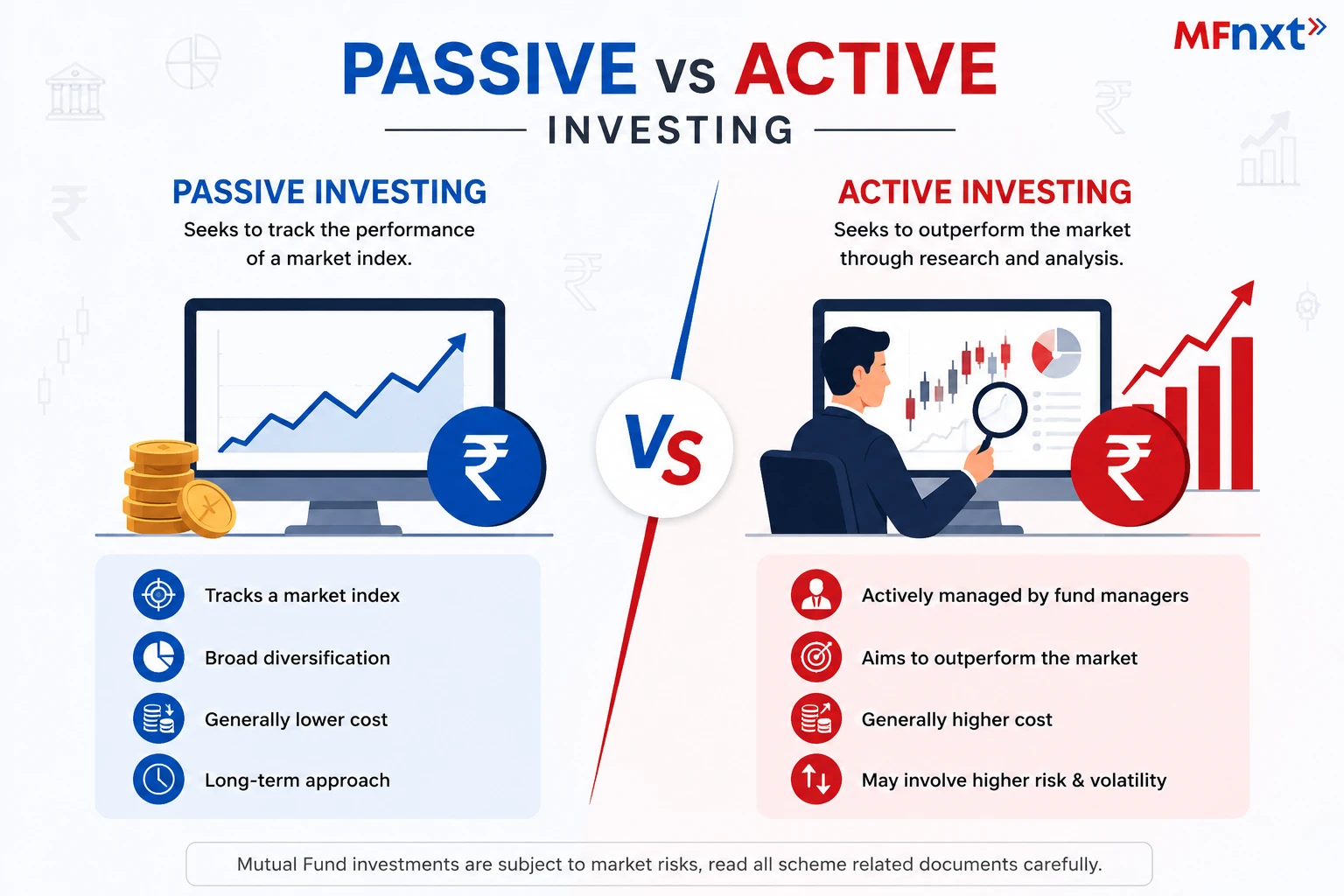
In this guide, we explain what is passive investing, what is active investing, the key differences between them, and factors investors commonly evaluate before selecting an investment approach.
Quick Summary
- 1. Passive investing aims to track the performance of a market index.
- 2. Active investing involves fund managers making investment decisions with the objective of outperforming a benchmark.
- 3. Costs, diversification, and fund management styles differ between the two approaches.
- 4. Both active and passive funds carry market-related risks.
- 5. The suitability of either approach depends on an investor's objectives and preferences.
What is Passive Investing?
Passive investing is an investment approach that seeks to replicate the performance of a specific market index rather than attempting to outperform it.
In passive investing, a fund generally invests in the same securities that make up the underlying benchmark index.
Examples of commonly tracked indices include:
- 1. Nifty 50
- 2. Nifty Next 50
- 3. Sensex
- 4. Nifty 500
Since the objective is to follow an index, portfolio changes usually occur when the benchmark index itself changes.
Many investors explore passive investing because it provides broad market exposure through a structured and rules-based investment approach.
You may also find our guide useful: What Are Index Funds in India?
What is Active Investing?
Active investing is an investment approach where professional fund managers actively select securities with the aim of achieving investment objectives that may differ from the benchmark index.
Fund managers conduct research, analyze companies, evaluate market conditions, and make portfolio allocation decisions based on their investment strategy.
Active funds may invest across:
- 1. Large-cap companies
- 2. Mid-cap companies
- 3. Small-cap companies
- 4. Sector-specific opportunities
- 5. Thematic investment ideas
The portfolio composition may change based on market conditions and the fund manager's assessment of opportunities and risks.
Looking for Index Funds?
You are in the right place. We have created investment baskets for you to choose from, based on your financial goals.
Explore BasketsPassive vs Active Investing: Key Differences
| Feature | Passive Investing | Active Investing |
|---|---|---|
| Objective | Track a market index | Managed according to a specific investment strategy |
| Portfolio Management | Rules-based | Fund manager driven |
| Security Selection | Mirrors benchmark index | Selected through research and analysis |
| Portfolio Changes | Generally based on index changes | May change based on investment decisions |
| Expense Ratio | Often lower compared to many active funds | May be higher due to active management |
| Benchmark Relationship | Attempts to replicate benchmark performance | May seek outcomes different from benchmark performance |
Costs and Expense Ratios
One of the commonly discussed differences between active and passive funds is the cost of managing the portfolio.
Passive Funds
Because passive funds typically follow a benchmark index, they often require less ongoing security selection and portfolio research.
As a result, many passive funds may have lower expense ratios compared to actively managed alternatives.
Active Funds
Active funds involve continuous research, security analysis, portfolio monitoring, and decision-making by fund managers and research teams.
These activities may contribute to higher fund management costs.
Investors often review expense ratios alongside other factors before making investment decisions.
Fund Manager Involvement
Passive Investing
In passive investing, the primary objective is to replicate the benchmark index as closely as possible.
Fund manager involvement generally focuses on:
- 1. Maintaining index alignment
- 2. Portfolio rebalancing
- 3. Managing tracking differences
- 4. Operational efficiency
Active Investing
In active investing, fund managers play a larger role in portfolio construction and ongoing decision-making.
Their responsibilities may include:
- 1. Researching companies
- 2. Evaluating sectors
- 3. Monitoring economic developments
- 4. Managing portfolio allocations
- 5. Reviewing investment risks
The investment strategy is often influenced by the fund manager's research process and investment philosophy.
Diversification
Diversification is an important consideration in both active and passive investing.
Passive Funds
Many passive funds provide exposure to multiple companies that form part of a benchmark index.
For example, a Nifty 50 Index Fund generally invests in the companies represented within the Nifty 50 index.
Active Funds
Diversification levels may vary depending on the investment strategy adopted by the fund manager.
Some active funds may maintain broad diversification, while others may focus on specific sectors, themes, or market capitalisations.
Risk Considerations
Both active and passive investing involve market-related risks.
Risks in Passive Investing
Passive funds generally follow market movements because they aim to track an index.
If the benchmark index declines, the fund's value may also be affected.
Risks in Active Investing
Active funds are subject to market risks and investment decision risks.
Portfolio performance may be influenced by:
- 1. Security selection decisions
- 2. Sector allocation decisions
- 3. Market conditions
- 4. Investment strategy execution
Investors should understand that neither approach eliminates market risk.
Active vs Passive Funds: Common Investor Considerations
When comparing active vs passive funds, investors often evaluate factors such as:
Investment Goals
The investment objective may influence fund selection.
Risk Tolerance
Different investors may have varying comfort levels with market fluctuations.
Investment Horizon
Short-term and long-term goals may require different considerations.
Costs
Expense ratios are commonly reviewed before investing.
Fund Strategy
Investors may evaluate whether they prefer a benchmark-tracking approach or an actively managed investment strategy.
Which Approach May Suit Different Investors?
There is no single investment approach that is universally suitable for every investor.
Some investors may prefer passive investing because of its index-tracking structure and broad market exposure.
Others may explore active investing because they prefer a professionally managed portfolio with active security selection.
Some investors also choose to include both active and passive funds within their overall portfolio, depending on their financial goals and investment preferences.
The suitability of any investment approach depends on individual circumstances, objectives, risk tolerance, and investment horizon.
Conclusion
Passive investing and active investing represent two different approaches to participating in financial markets. While passive investing generally focuses on tracking a benchmark index, active investing involves ongoing portfolio decisions by fund managers.
The suitability of either approach depends on an investor's financial goals, investment horizon, risk tolerance, and personal preferences. Understanding the differences can help investors make informed decisions when evaluating investment options.
Frequently Asked Questions
What is passive investing?
Passive investing is an investment approach that aims to track the performance of a market index rather than actively selecting securities.
What is active investing?
Active investing involves professional fund managers making investment decisions based on research, analysis, and portfolio management strategies.
What is the difference between passive and active investing?
The primary difference is that passive investing seeks to replicate an index, while active investing involves portfolio management decisions made by fund managers.
Are passive funds and active funds both subject to market risks?
Yes. Both passive funds and active funds are market-linked investments and are subject to investment risks.
Can investors choose both active and passive funds?
Some investors include both active and passive funds in their portfolio based on their investment objectives and preferences.
Related Articles
This article is intended for educational and informational purposes only. It should not be considered investment advice or a recommendation to buy, sell or hold any particular mutual fund or security.
Mutual fund investments are subject to market risks. Please read all scheme-related documents carefully before investing.