
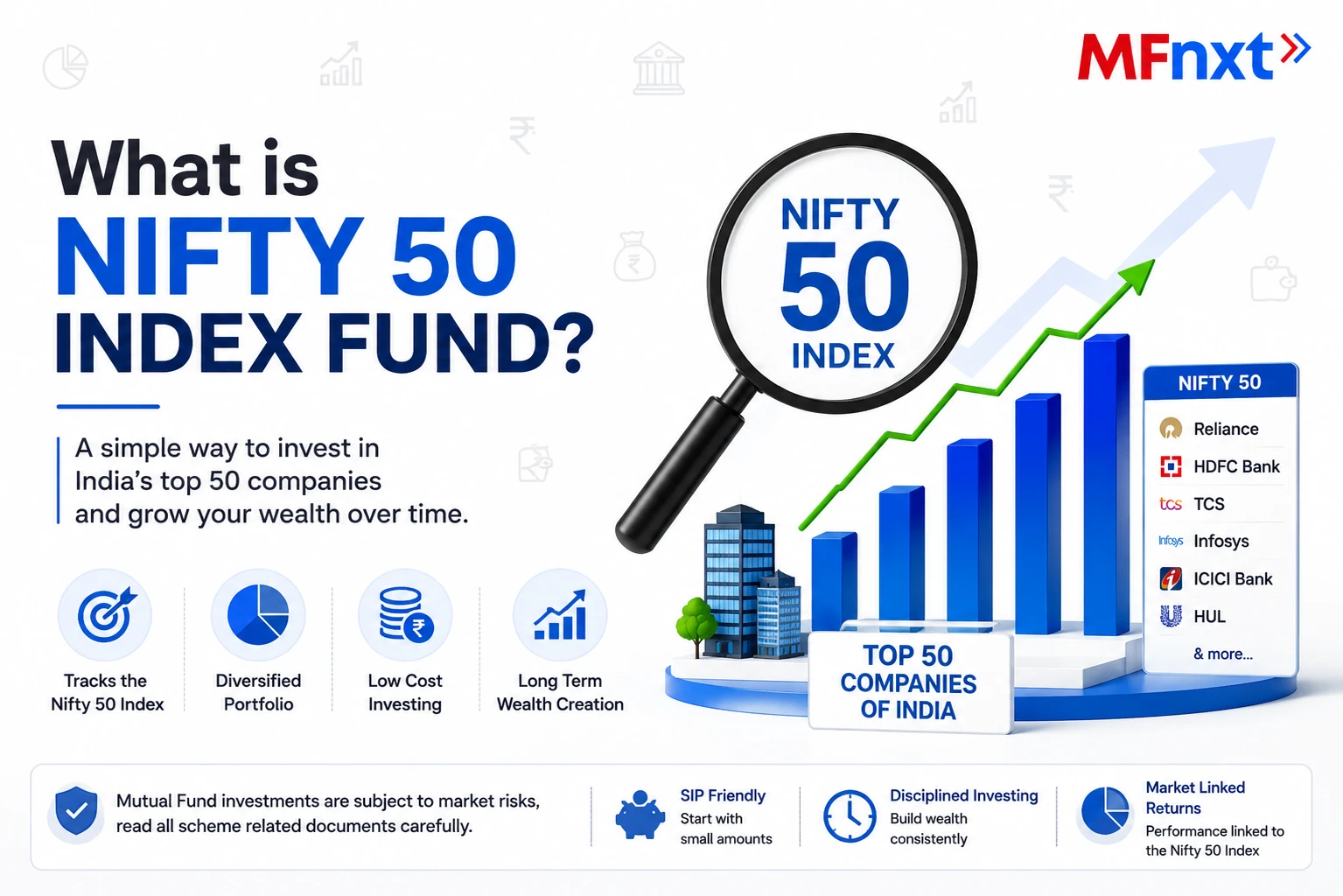
But what exactly is a Nifty 50 Index Fund, how does it work, and why do many investors consider it as part of their investment journey?
In this guide, we explain the Nifty 50 Index Fund meaning, how it works, key features, benefits, risks, and factors investors commonly evaluate before investing.
Quick Summary
- 1. A Nifty 50 Index Fund aims to track the Nifty 50 Index.
- 2. The Nifty 50 represents 50 large companies listed on the National Stock Exchange (NSE).
- 3. Nifty 50 Index Funds follow a passive investing approach.
- 4. Investors can generally invest through SIP or lump sum methods.
- 5. Returns are linked to the performance of the underlying index.
What is Nifty 50 Index Fund?
A Nifty 50 Index Fund is a type of mutual fund that aims to replicate the performance of the Nifty 50 Index.
Instead of actively selecting stocks, the fund generally invests in the same companies that form part of the Nifty 50 and in similar proportions.
The objective is not to outperform the market but to closely track the performance of the benchmark index.
This investment approach is commonly referred to as passive investing.
If you're new to passive investing, you may also find our guide on Passive vs Active Investing helpful.
Nifty 50 Index Fund Meaning
To understand the Nifty 50 Index Fund meaning, it is important to first understand the Nifty 50 Index itself.
The Nifty 50 is a benchmark stock market index that represents 50 large and liquid companies listed on the National Stock Exchange (NSE). The index is calculated using a free-float market capitalization methodology and is designed to reflect the performance of a broad segment of the Indian equity market.
Because the index includes companies across multiple sectors, it provides diversified exposure to the Indian stock market.
A Nifty 50 Index Fund seeks to mirror this index as closely as possible.
Looking for Index Funds?
You are in the right place. We have created investment baskets for you to choose from, based on your financial goals.
Explore BasketsHow Does a Nifty 50 Index Fund Work?
A Nifty 50 Index Fund generally invests in the same companies that are part of the Nifty 50 Index.
When the composition of the Nifty 50 changes, the fund may adjust its portfolio accordingly to continue tracking the benchmark.
Since the fund follows a predefined index, investment decisions are generally based on the benchmark methodology rather than active stock selection.
This is one of the key differences between passive investing and actively managed mutual funds.
You may also explore our detailed comparison: Index Funds vs Mutual Funds
What Companies Are Included in the Nifty 50?
The Nifty 50 consists of 50 large-cap companies from various sectors of the Indian economy. The index is reviewed periodically and uses eligibility criteria such as free-float market capitalization and liquidity.
These companies may belong to sectors such as:
- 1. Financial Services
- 2. Information Technology
- 3. Energy
- 4. Consumer Goods
- 5. Automobile
- 6. Healthcare
- 7. Telecommunications
Because of this sector diversification, investors gain exposure to multiple segments of the economy through a single investment.
Benefits of Nifty 50 Index Funds
1. Diversification
A Nifty 50 Index Fund provides exposure to multiple companies across sectors through a single investment.
2. Passive Investing Approach
The fund follows a benchmark index rather than relying on active stock selection.
3. Simplicity
Many investors find Index Funds easier to understand because they follow a transparent index-tracking methodology.
4. Broad Market Exposure
Investors receive exposure to some of the largest listed companies in India.
5. Lower Expense Ratios
Because Nifty 50 Index Funds generally follow a passive investing strategy, they often have lower expenses compared with many actively managed funds.
You may also find our guide on What Are Index Funds in India? useful for understanding how index-based investing works.
Risks of Nifty 50 Index Funds
Like all market-linked investments, Nifty 50 Index Funds involve risks.
Market Risk
If the underlying index declines, the value of the investment may also be affected.
Tracking Error
A fund may not perfectly match the performance of the benchmark index due to operational and portfolio management factors.
Equity Market Volatility
Short-term market fluctuations can impact investment values.
Investors should understand these risks before investing.
SIP vs Lump Sum in Nifty 50 Index Funds
Investors generally have two common investment methods.
SIP Investing
A Systematic Investment Plan (SIP) allows investors to invest a fixed amount periodically.
Lump Sum Investing
A lump sum investment involves investing a larger amount at one time.
The choice depends on individual financial circumstances and investment objectives.
You can learn more in our guide: How to Invest in Index Funds in India
Who May Explore Nifty 50 Index Funds?
- Investors seeking diversified exposure.
- Investors exploring passive investing.
- Long-term investors.
- Investors who prefer benchmark-tracking strategies.
- Investors looking for broad market exposure.
Nifty 50 Index Fund vs Actively Managed Mutual Funds
A Nifty 50 Index Fund generally seeks to track the benchmark index.
An actively managed mutual fund involves portfolio decisions made by professional fund managers who select investments based on their research and investment strategy.
Both approaches have different characteristics and may suit different investors.
Neither approach is inherently superior. The suitability of any investment approach depends on an investor's financial goals, investment horizon, risk tolerance, and personal preferences.
For a detailed comparison, read: Passive vs Active Investing
Common Mistakes Investors Should Avoid
Investing Without a Goal
Having a clear investment objective can help investors stay focused.
Ignoring Risk Factors
All market-linked investments carry risks.
Chasing Short-Term Performance
Short-term market movements may not reflect long-term outcomes.
Not Understanding the Product
Investors should review scheme documents and understand investment objectives before investing.
Conclusion
A Nifty 50 Index Fund is a mutual fund that aims to track the performance of the Nifty 50 Index, one of India's most widely followed market benchmarks.
Many investors explore Nifty 50 Index Funds because they offer diversified market exposure, simplicity, and a passive investing approach.
Before investing, investors should understand the fund's objective, risks, costs, and how it aligns with their financial goals.
If you're beginning your investment journey, you may also find these guides useful:
This article is intended for educational and informational purposes only. It should not be considered investment advice or a recommendation to buy, sell or hold any particular mutual fund or security.
Mutual fund investments are subject to market risks. Please read all scheme-related documents carefully before investing.