
However, no index fund can perfectly replicate an index every single day.
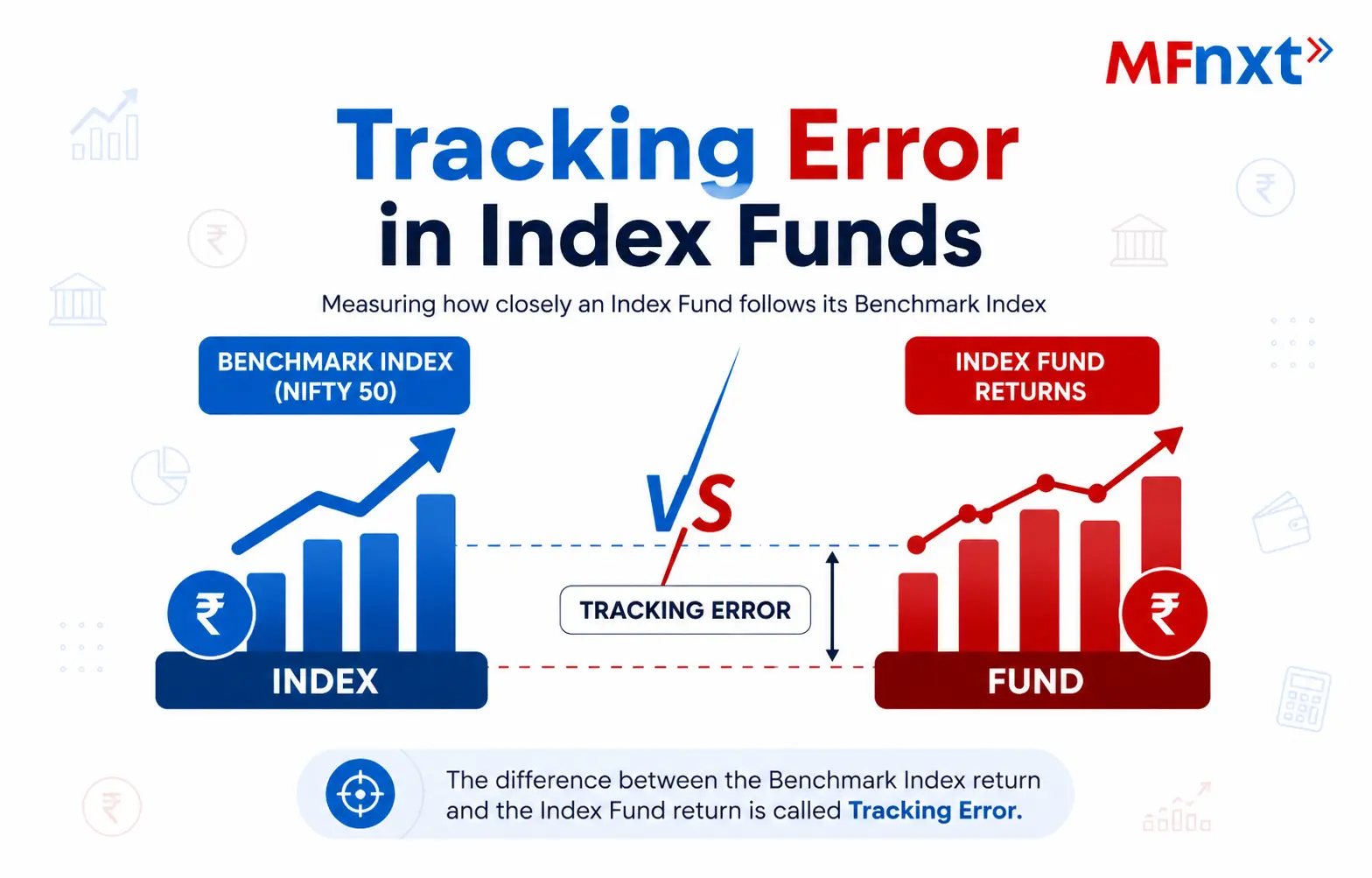
The small difference between the benchmark's return and the return delivered by an index fund is known as Tracking Error.
Although it may appear to be a technical term, understanding Tracking Error is essential for anyone investing in passive funds.
In this guide, we'll explain what Tracking Error means, why it occurs, how it affects investment performance, and what investors should consider while evaluating an index fund.
Quick Summary
- 1. Tracking Error measures how closely an Index Fund follows its benchmark index.
- 2. A lower Tracking Error generally indicates closer replication of the benchmark.
- 3. Expense Ratio, cash holdings, transaction costs, and portfolio rebalancing can contribute to Tracking Error.
- 4. Tracking Error is only one factor to consider when evaluating an Index Fund.
- 5. Understanding Tracking Error helps investors make informed long-term investment decisions.
Why Understanding Tracking Error Matters
One of the biggest advantages of investing in Index Funds is that they aim to replicate the performance of a benchmark index rather than trying to outperform it.
Unlike actively managed mutual funds, index funds follow a passive investment strategy, making consistency one of their most important characteristics.
However, even the most efficiently managed index fund cannot exactly match the returns of its benchmark every single day. Small differences occur because of various operational and market-related factors.
These differences are measured using a metric known as Tracking Error.
For investors, understanding Tracking Error is important because it provides insight into how efficiently an index fund follows its benchmark.
A fund that consistently stays close to the benchmark is generally considered to be tracking the index effectively.
If you're new to passive investing, we recommend first reading our guide on What is an Index Fund in India?, which explains how index funds work before diving into advanced concepts like Tracking Error.
Looking for Index Funds?
You are in the right place. We have created investment baskets for you to choose from, based on your financial goals.
Explore BasketsWhat is Tracking Error?
Tracking Error is a statistical measure that indicates how closely an Index Fund follows the returns of its benchmark index over a period of time.
Every Index Fund is designed to mirror an underlying index such as the Nifty 50, Nifty Next 50, or Sensex.
Since perfect replication is rarely possible, there is usually a small variation between the benchmark's performance and the fund's actual performance.
Tracking Error measures how consistently an Index Fund follows the performance of its benchmark index.
A lower Tracking Error generally indicates that the fund is doing a better job of replicating its benchmark.
However, Tracking Error should always be evaluated together with other important factors such as Expense Ratio, portfolio construction, and investment objectives.
Understanding Tracking Error with a Simple Example
Suppose you invest in two Index Funds that both track the Nifty 50 Index.
| Investment | Annual Return |
|---|---|
| Nifty 50 Index | 12.00% |
| Index Fund A | 11.92% |
| Index Fund B | 11.18% |
Although both funds follow the same benchmark, Index Fund A has remained much closer to the benchmark's return than Index Fund B.
This doesn't automatically make Index Fund A "better," but it does indicate that it has tracked the benchmark more consistently during this period.
A lower Tracking Error generally means the fund has stayed closer to its benchmark index. Since Index Funds aim to replicate rather than outperform the market, maintaining consistency is one of their primary objectives.
How is Tracking Error Calculated?
Tracking Error is calculated using statistical methods that measure the variability of the difference between an Index Fund's returns and the returns of its benchmark over a period of time.
Investors generally rely on fund houses or research platforms to review this metric rather than calculating it themselves.
Why Does Tracking Error Happen?
Many first-time investors assume that an Index Fund simply buys all the companies in an index and therefore should generate exactly the same return as the benchmark.
In reality, managing an Index Fund involves several operational activities that can create small differences in performance.
Some of the most common reasons include:
- 1. Expense Ratio deducted by the mutual fund.
- 2. Cash Holdings maintained for liquidity and investor transactions.
- 3. Portfolio Rebalancing when benchmark constituents change.
- 4. Transaction Costs such as brokerage, taxes and settlement expenses.
- 5. Corporate Actions including dividends, mergers, bonus issues and stock splits.
- 6. Timing Differences between benchmark changes and fund execution.
We'll discuss each of these factors in detail in the next section.
Tracking Error vs Investment Returns
One common misconception is that a fund with a lower return always has a high Tracking Error. This is not necessarily true.
Tracking Error measures consistency of replication, not whether the market has gone up or down.
Even if the benchmark delivers negative returns during a market correction, a well-managed Index Fund can still maintain a low Tracking Error by closely following the benchmark.
| Feature | Tracking Error | Investment Return |
|---|---|---|
| Purpose | Measures consistency | Measures profit or loss |
| Indicates | How closely a fund follows its benchmark | How much an investment has gained or lost |
| Lower Value Preferred? | Generally Yes | Depends on market performance |
| Affected By | Fund operations, expenses, cash holdings | Market movements |
If you'd like to understand why Index Funds generally have lower operating costs than actively managed funds, read our article on Passive vs Active Investing.
You may also find these educational guides helpful:
Factors That Affect Tracking Error
Tracking Error doesn't happen because an Index Fund is poorly managed. Even the most efficiently managed index funds experience small differences from their benchmark due to normal investment operations.
Understanding these factors can help investors evaluate index funds more effectively instead of focusing only on returns.
1. Expense Ratio
One of the biggest contributors to Tracking Error is the Expense Ratio. Every mutual fund charges a small annual fee to manage and operate the fund.
Since this cost is deducted from the fund's assets, the returns delivered to investors become slightly lower than the benchmark index.
For example, if the benchmark generates a return of 12.00% and the fund charges an expense ratio of 0.20%, the investor's return may be slightly lower after accounting for operational costs.
Most Index Funds have significantly lower Expense Ratios compared to actively managed mutual funds because they simply track an index instead of actively selecting stocks.
2. Cash Holdings
Although Index Funds aim to remain fully invested, they usually maintain a small amount of cash.
Cash may be required for:
- 1. Investor purchases and redemptions
- 2. Dividend distributions
- 3. Daily fund operations
- 4. Meeting liquidity requirements
Since cash doesn't participate in stock market movements like the benchmark index, temporary cash holdings may slightly affect performance and contribute to Tracking Error.
3. Portfolio Rebalancing
Market indices such as the Nifty 50 and Sensex are reviewed periodically.
Companies may be added or removed from these indices depending on their market capitalization, liquidity, and eligibility criteria.
Whenever such changes occur, Index Funds also need to buy and sell securities to match the revised benchmark composition.
Since these transactions cannot always happen at the exact same time or price as the benchmark calculation, temporary differences may arise.
| Benchmark Changes | Index Fund Action |
|---|---|
| Company Added | Fund purchases the stock |
| Company Removed | Fund exits the stock |
| Weight Changes | Fund adjusts portfolio allocation |
4. Transaction Costs
Every time an Index Fund buys or sells securities, certain transaction-related expenses are incurred.
These may include:
- 1. Brokerage charges
- 2. Securities Transaction Tax (STT)
- 3. Exchange transaction charges
- 4. Stamp duty
- 5. Settlement costs
Although these costs are usually small, they can collectively contribute to Tracking Error over time.
5. Corporate Actions
Companies included in an index regularly announce corporate actions.
Examples include:
- 1. Dividends
- 2. Bonus Issues
- 3. Stock Splits
- 4. Rights Issues
- 5. Mergers & Acquisitions
Managing these events while maintaining accurate benchmark replication requires operational adjustments by the fund manager.
These temporary adjustments may create small deviations from the benchmark.
6. Timing Difference
Benchmark indices are calculated continuously during market hours.
However, Index Funds execute transactions only when orders are placed and settled.
This timing difference between benchmark calculation and actual trade execution can also contribute to Tracking Error.
7. Cash Inflows and Redemptions
Every day, investors invest new money into Index Funds while others redeem their investments.
Fund managers need to deploy this money efficiently while maintaining the benchmark allocation.
During this process, temporary cash positions may exist, resulting in slight deviations from benchmark performance.
Tracking Error is a normal characteristic of every Index Fund. The objective is not to eliminate it completely, but to keep it as low and consistent as reasonably possible.
Tracking Error vs Tracking Difference
Many investors use these two terms interchangeably, but they measure different aspects of an Index Fund's performance.
| Feature | Tracking Error | Tracking Difference |
|---|---|---|
| Meaning | Measures consistency of deviations | Measures average difference in returns |
| Focus | Volatility of deviations | Difference in performance |
| Statistical Measure | Yes | No |
| Preferred Value | Lower | Closer to Zero |
Think of it this way:
- Tracking Difference tells you how much the fund differs from its benchmark.
- Tracking Error tells you how consistently those differences occur over time.
Should Investors Worry About Tracking Error?
For most long-term investors, Tracking Error is only one of several factors to consider. A slightly higher Tracking Error does not automatically make an Index Fund unsuitable.
Instead, investors should evaluate the overall investment strategy, benchmark, expense ratio, portfolio diversification, and long-term consistency together.
If you're still deciding whether passive investing suits your financial goals, you may also like these guides:
Conclusion
Tracking Error is an important concept for anyone investing in Index Funds.
It measures how closely an index fund follows its benchmark and provides insight into the efficiency of the fund's replication strategy.
While a lower Tracking Error generally indicates that an index fund is closely tracking its benchmark, it should not be viewed in isolation.
Factors such as the benchmark index, expense ratio, fund size, investment process, and long-term consistency should also be considered before making investment decisions.
For long-term investors, understanding concepts like Tracking Error can help set realistic expectations and build confidence in passive investing.
Instead of focusing only on short-term returns, evaluating how consistently an index fund follows its benchmark can provide a more complete picture of its performance.
If you're beginning your passive investing journey, you may also find these educational resources useful:
Frequently Asked Questions (FAQs)
1. What is Tracking Error in an Index Fund?
Tracking Error measures how closely an Index Fund follows the performance of its benchmark index. It indicates the consistency of the fund in replicating the benchmark's returns over time.
2. Why does Tracking Error occur?
Tracking Error may occur due to factors such as expense ratio, cash holdings, transaction costs, portfolio rebalancing, corporate actions, and timing differences while replicating the benchmark.
3. Is a lower Tracking Error always better?
Generally, a lower Tracking Error indicates that the Index Fund has tracked its benchmark more closely. However, investors should also consider factors such as the benchmark index, expense ratio, investment objective, and long-term consistency.
4. Can an Index Fund have zero Tracking Error?
In practice, achieving zero Tracking Error is extremely difficult because Index Funds incur operating expenses and face practical limitations while replicating the benchmark.
5. What is the difference between Tracking Error and Tracking Difference?
Tracking Difference measures the average difference between the returns of an Index Fund and its benchmark, whereas Tracking Error measures how consistently those differences occur over time.
6. Does a higher Expense Ratio increase Tracking Error?
The expense ratio is one of the factors that may contribute to differences between an Index Fund's performance and its benchmark. It should be evaluated along with other factors affecting fund performance.
7. How often should investors check Tracking Error?
Tracking Error is generally evaluated over longer periods rather than on a daily basis. Reviewing it periodically along with other fund metrics may provide a better understanding of how consistently the fund has tracked its benchmark.
8. Should Tracking Error be the only factor while choosing an Index Fund?
No. Investors may consider Tracking Error along with the benchmark index, expense ratio, fund size, investment objective, portfolio construction, and long-term performance before making investment decisions.
9. Is Tracking Error relevant only for Index Funds?
Tracking Error is most commonly associated with Index Funds and ETFs because they aim to replicate a benchmark index. It helps assess how closely these funds follow their stated benchmark.
10. Why is Tracking Error important for long-term investors?
Understanding Tracking Error helps investors evaluate how efficiently an Index Fund follows its benchmark over time. It is one of several factors that may be considered when assessing passive investment options.
This article is intended for educational and informational purposes only. It should not be considered investment advice or a recommendation to buy, sell or hold any particular mutual fund or security.
Mutual fund investments are subject to market risks. Please read all scheme-related documents carefully before investing.