If you are exploring Index Funds in India, two benchmarks you are likely to come across are the Nifty 50 and the Nifty Next 50.
Although their names sound similar, the two indices represent different sets of companies and can behave differently across market cycles.
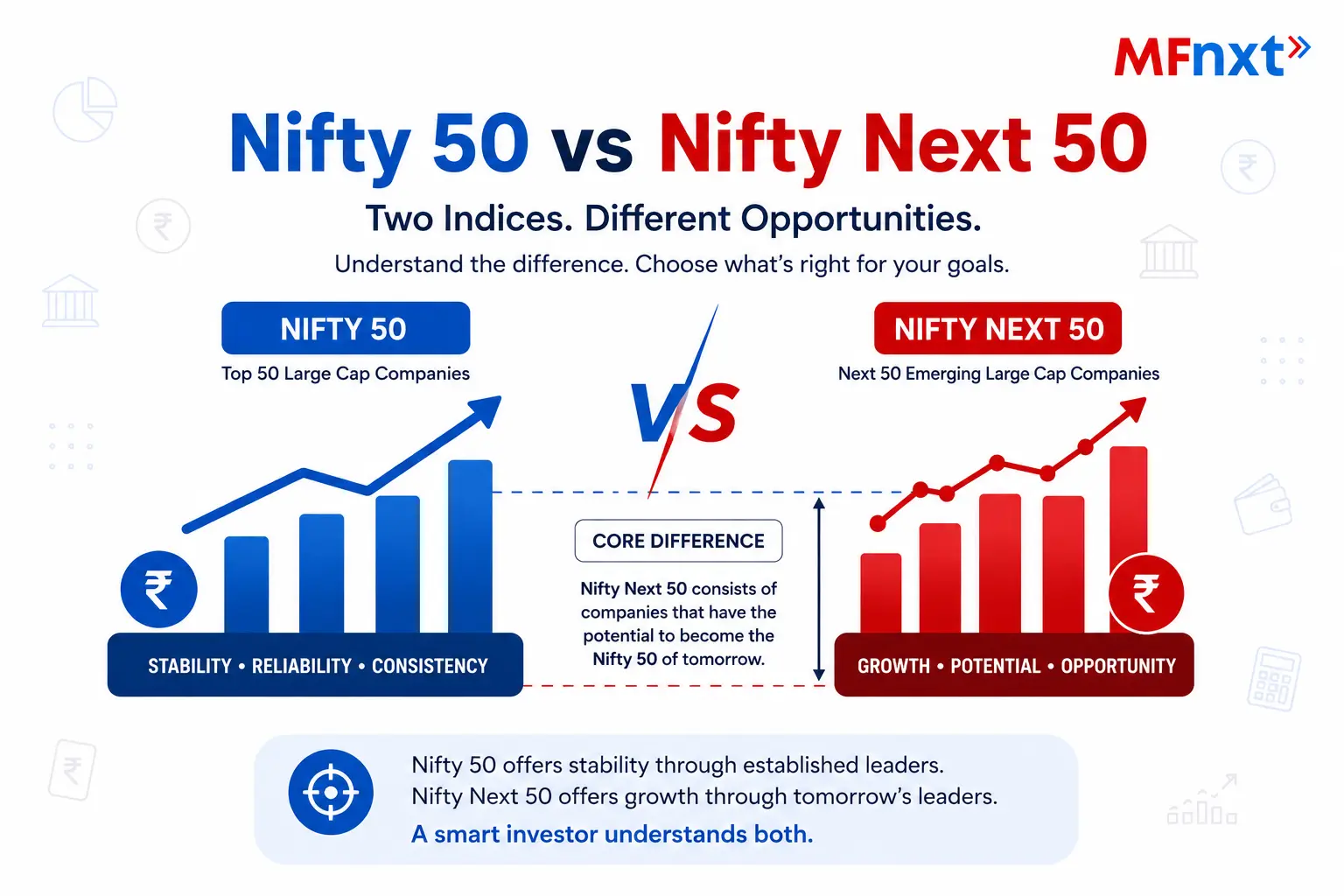
Think of them as two different groups of companies. The Nifty 50 represents 50 of India's leading large companies, while the Nifty Next 50 represents the next 50 companies within the Nifty 100.
Understanding the difference between the Nifty 50 vs Nifty Next 50 can help investors better understand benchmark selection, portfolio exposure, volatility and the characteristics of Index Funds tracking these indices.
In this guide, we explain the difference between Nifty 50 and Nifty Next 50, how the indices are constructed, their risk characteristics, how Index Funds track them and the factors investors may consider before investing.
Nifty 50 vs Nifty Next 50
- Nifty 50 represents 50 large and liquid companies across important sectors of the Indian economy.
- Nifty Next 50 represents 50 companies from the Nifty 100 after excluding the Nifty 50 constituents.
- Both indices are calculated using a free-float market capitalisation methodology.
- Their company composition, sector exposure and historical volatility can differ considerably.
- Index Funds tracking either benchmark remain equity mutual fund investments and are subject to market risks.
Why Compare Nifty 50 and Nifty Next 50?
An Index Fund attempts to replicate the performance of a particular benchmark. Therefore, understanding the benchmark is an important part of understanding the Index Fund itself.
Two Index Funds can both be passively managed but still provide very different investment exposure if they track different indices.
For example, an Index Fund tracking the Nifty 50 provides exposure to the companies represented by the Nifty 50, whereas a Nifty Next 50 Index Fund provides exposure to a different set of companies represented by the Nifty Next 50.
The key difference is the group of companies represented by each benchmark.
Nifty 50 and Nifty Next 50 are related indices, but they provide exposure to different constituents of the Indian equity market.
If you are new to passive investing, you can also read our guide: What is an Index Fund?
What is the Nifty 50 Index?
The Nifty 50 is a diversified 50-stock index representing important sectors of the Indian economy.
It is one of the most widely followed benchmarks of the Indian equity market and is maintained by NSE Indices Limited.
The Nifty 50 uses a free-float market capitalisation weighted methodology. In simple terms, companies with a higher free-float market value generally have a larger weight in the index.
Because the index contains companies from multiple sectors, it provides diversified exposure to a segment of India's large listed companies.
Want to understand the Nifty 50 in more detail? Read our complete guide: What is the Nifty 50 Index?
What is the Nifty Next 50 Index?
The Nifty Next 50 represents the next 50 companies after the Nifty 50 within the broader Nifty 100 Index.
It therefore represents a separate group of companies within the broader Nifty 100 universe.
Like the Nifty 50, the Nifty Next 50 is calculated using a free-float market capitalisation methodology.
Index constituents are not permanent. NSE Indices periodically reviews its indices, and constituent companies can change according to the applicable index methodology and eligibility criteria.
Nifty 50 vs Nifty Next 50: Key Differences
| Feature | Nifty 50 | Nifty Next 50 |
|---|---|---|
| Number of Companies | 50 | 50 |
| Index Universe | Companies included in the Nifty 50 | Companies from Nifty 100 excluding Nifty 50 constituents |
| Weighting Method | Free-float market capitalisation | Free-float market capitalisation |
| Company Exposure | Large and liquid companies represented by the Nifty 50 | The next set of companies represented within the Nifty 100 universe |
| Historical Volatility | Has differed across market cycles | Has differed across market cycles and may experience significant fluctuations |
| Investment Route | Index Funds and ETFs may track the benchmark | Index Funds and ETFs may track the benchmark |
| Market Risk | Yes | Yes |
The characteristics of an index can change over time as constituents and weights are periodically reviewed. Historical behaviour should not be interpreted as an indication of future performance.
How Are Nifty 50 and Nifty Next 50 Companies Selected?
NSE Indices follows defined index methodologies for constituent selection, eligibility and periodic review.
Factors considered under the applicable methodology can include areas such as market capitalisation, liquidity and other eligibility requirements.
The important point for investors is that the composition of an index can change over time.
When the underlying index changes, an Index Fund tracking that benchmark generally needs to adjust its portfolio accordingly in order to continue tracking the index.
Nifty 50 vs Nifty Next 50: Market Exposure
One important distinction between the two benchmarks is the set of companies represented by each index.
The Nifty 50 provides exposure to 50 companies included in the index, while the Nifty Next 50 provides exposure to the next 50 companies within the broader Nifty 100.
Therefore, holding funds tracking both indices can result in exposure across different constituents of the Nifty 100 universe.
However, broader exposure does not automatically mean lower risk or higher returns. Equity investments remain subject to market movements.
Nifty 50 vs Nifty Next 50 Returns: What Should Investors Understand?
Searches for Nifty 50 vs Nifty Next 50 returns are common, but historical returns should be interpreted carefully.
There have been market periods in which one index has performed better than the other. Leadership can change as economic conditions, sector performance, company earnings, valuations and market sentiment change.
Therefore, looking only at the index that generated the highest recent return can provide an incomplete picture.
Past performance may or may not be sustained in the future. Historical index returns should not be considered an assurance, prediction or guarantee of future returns.
Nifty 50 vs Nifty Next 50: Risk and Volatility
Both benchmarks represent equities. Therefore, Index Funds tracking either benchmark are exposed to equity market risk.
The indices can experience different levels of volatility because their constituents, company weights and sector exposures are different.
Market corrections can affect both indices, and investors should not assume that an Index Fund is low-risk simply because it follows an index.
| Risk Consideration | What It Means |
|---|---|
| Market Risk | The value of equity securities can rise or fall with market conditions. |
| Volatility | Different indices can experience different levels of price fluctuations. |
| Concentration | Sector and constituent weights can influence index performance. |
| Tracking Risk | An Index Fund may not replicate its benchmark perfectly. |
| Liquidity & Transaction Impact | Portfolio implementation and rebalancing can influence tracking. |
Tracking Error Matters in Both Index Funds
Choosing a benchmark is only one part of evaluating an Index Fund. Investors may also examine how effectively the fund tracks that benchmark.
An Index Fund's return may differ from its benchmark due to factors such as expenses, cash holdings, transaction costs, rebalancing and implementation differences.
This is where tracking error and tracking difference become relevant.
Read our detailed guide: What is Tracking Error in Index Funds?
Nifty 50 vs Nifty Next 50 for SIP Investing
A Systematic Investment Plan (SIP) is a method of investing a fixed amount periodically in a mutual fund scheme.
SIP itself does not remove the market risk associated with the underlying investment.
Index Funds tracking the Nifty 50 and Nifty Next 50 may both offer SIP facilities, depending on the mutual fund scheme.
The fact that an investment is made through SIP should not be interpreted as an assurance of returns or protection against loss.
An investor contributing ₹10,000 every month through a SIP will purchase units at the applicable NAV on different investment dates. The eventual value of the investment will depend on the performance of the underlying scheme and market conditions. Returns are not guaranteed.
Key Characteristics of a Nifty 50 Index Fund
A Nifty 50 Index Fund generally seeks to replicate the Nifty 50 benchmark, subject to the scheme's investment objective and methodology.
- Provides exposure to the Nifty 50 constituents.
- Follows a passive investment approach.
- Portfolio composition changes when the underlying benchmark changes.
- Returns can differ from the benchmark because of tracking difference and other factors.
- The investment remains subject to equity market risk.
Key Characteristics of a Nifty Next 50 Index Fund
A Nifty Next 50 Index Fund generally seeks to replicate the Nifty Next 50 benchmark, subject to the scheme's investment objective and methodology.
- Provides exposure to Nifty Next 50 constituents.
- Tracks companies from the Nifty 100 after excluding Nifty 50 constituents.
- Follows a passive investment approach.
- Its risk and return behaviour can differ from a Nifty 50 Index Fund.
- The investment remains subject to equity market risk.
Can You Invest in Both Nifty 50 and Nifty Next 50 Index Funds?
It is possible to invest in funds tracking both benchmarks. Doing so can provide exposure to different constituents within the Nifty 100 universe.
However, whether such an allocation is appropriate cannot be determined solely from the indices themselves.
Factors such as financial objectives, investment horizon, risk profile, existing portfolio exposure and scheme-specific characteristics may need to be considered before making an investment decision.
What Should You Check Before Choosing an Index Fund?
Whether you are evaluating a Nifty 50 Index Fund, Nifty Next 50 Index Fund, or another passive fund, the benchmark is only one factor to consider.
Investors may also review:
Understand exactly which index the scheme seeks to track.
Understand how closely the fund has tracked its benchmark.
Costs can influence the difference between scheme and benchmark returns.
Read the Scheme Information Document to understand how the scheme operates.
Review the applicable Riskometer and understand the risk level of the scheme.
Consider whether the investment aligns with your financial objective and investment horizon.
Common Mistakes While Comparing Nifty 50 and Nifty Next 50
- Choosing an Index Fund only because its recent returns are higher.
- Assuming an Index Fund is risk-free because it is passively managed.
- Ignoring tracking difference and tracking error.
- Assuming SIP guarantees positive returns.
- Selecting an investment without considering financial objectives and risk profile.
Nifty 50 vs Nifty Next 50: Myth vs Fact
| Common Belief | What Investors Should Understand |
|---|---|
| Nifty Next 50 always gives higher returns than Nifty 50. | No. Relative performance can change across market cycles. |
| Nifty 50 Index Funds are risk-free. | No. They invest in equities and remain subject to market risk. |
| All Index Funds deliver exactly the benchmark return. | No. Expenses and portfolio implementation can result in tracking difference. |
| SIP guarantees positive returns. | No. SIP is an investment method and does not guarantee returns or eliminate market risk. |
| The index with the highest recent return is automatically the better investment. | No. Recent performance alone does not establish future suitability or performance. |
Nifty 50 or Nifty Next 50: Which One Should You Consider?
There is no single answer that applies to every investor.
The Nifty 50 and Nifty Next 50 represent different groups of companies, and their risk and return characteristics can differ over time.
Instead of asking only which index generated higher returns in the past, it may be more useful to understand:
- Which benchmark the fund tracks
- What companies and sectors the benchmark represents
- How volatile the benchmark has been
- How closely the fund tracks its benchmark
- The scheme's expense ratio and other costs
- The applicable Riskometer
- Your investment objective, horizon and risk profile
Nifty 50 vs Nifty Next 50 is not simply a question of which index is “better.”
They provide different market exposures. Understanding those differences can help investors make more informed decisions about Index Funds that track them.
Frequently Asked Questions About Nifty 50 vs Nifty Next 50
What is the main difference between Nifty 50 and Nifty Next 50?
The Nifty 50 represents 50 large and liquid companies across important sectors of the Indian economy. The Nifty Next 50 represents 50 companies from the Nifty 100 after excluding the Nifty 50 constituents.
Is Nifty Next 50 the same as Nifty 50?
No. They are separate indices with different constituents, although both form part of the broader Nifty 100 universe.
Can a company move from Nifty Next 50 to Nifty 50?
Index constituents are periodically reviewed. Companies can enter or exit indices according to the applicable eligibility criteria and index methodology.
Is Nifty 50 risk-free?
No. Nifty 50 represents equities, and Index Funds tracking it remain subject to equity market risk.
Is Nifty Next 50 more volatile than Nifty 50?
The two indices can display different volatility across market periods because their constituents and sector exposures differ. Historical volatility should not be interpreted as a prediction of future behaviour.
Which gives better returns: Nifty 50 or Nifty Next 50?
Relative performance changes across market cycles. Past performance of either index does not guarantee or predict future returns.
Can I invest through SIP in Nifty 50 and Nifty Next 50 Index Funds?
Mutual fund schemes tracking these benchmarks may offer SIP facilities. Investors should check the relevant scheme documents for available investment facilities and terms.
Does SIP reduce the risk of an Index Fund?
SIP is a method of investing periodically. It does not eliminate market risk or guarantee positive returns.
Can investors hold both Nifty 50 and Nifty Next 50 Index Funds?
It is possible to hold funds tracking both benchmarks. Whether such an allocation is appropriate depends on factors including financial objectives, risk profile, investment horizon and existing portfolio exposure.
What should I check before investing in an Index Fund?
Investors may consider the underlying benchmark, scheme investment objective, Riskometer, expense ratio, tracking difference, tracking error and other scheme-specific information. Scheme-related documents should be read carefully before investing.
Are Nifty 50 and Nifty Next 50 Index Funds actively managed?
Index Funds are passive investment products that generally seek to replicate the performance of their specified benchmark, subject to tracking difference and the scheme investment strategy.
What is tracking error in a Nifty Index Fund?
Tracking error is a measure associated with how consistently a fund’s returns differ from the returns of its benchmark. Various implementation factors can cause an Index Fund to deviate from its benchmark.
Conclusion
If you want to understand Index Investing in greater depth, explore these MFnxt guides.
Continue Learning About Index Funds
This article is intended for educational and informational purposes only. It should not be considered investment advice or a recommendation to buy, sell or hold any particular mutual fund or security.
Mutual fund investments are subject to market risks. Please read all scheme-related documents carefully before investing.