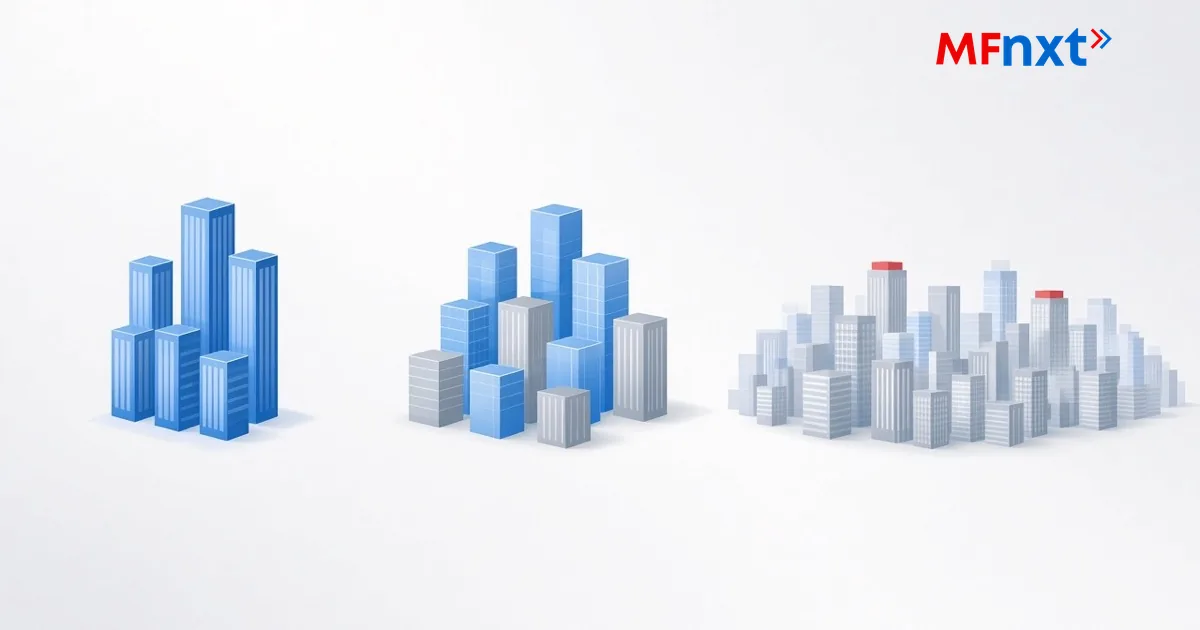
Fund lists often place the Nifty 50, the Nifty 500 and Nifty Total Market next to one another. The names make them sound like a small market, a bigger market and the whole market.
The useful question is simpler: which companies does each index include?
The Nifty 50 follows 50 large, liquid companies. The Nifty 500 covers a much broader group of companies. Nifty Total Market extends its coverage further by including the Nifty Microcap 250 universe alongside the Nifty 500.
An index is a published list of companies, with a rule for how much each one counts. A mutual fund is a separate product that may try to follow that list.
What an index fund is explains that step. Nifty 50 versus Nifty Next 50 is a different comparison, and it stays inside the large-company hundred.
The Nifty 50
NSE Indices selects the Nifty 50 from the Nifty 100. The result is 50 large companies whose shares are actively traded.
It is the index many people have in mind when they say “the market”, and it still leaves out most listed companies.
Each company does not get an equal slice. A larger free-float market value carries more weight.
Free float means the shares the public can buy and sell. Shares held tightly by promoters do not count in the same way.
What the Nifty 50 index is stays with this one benchmark.
The Nifty 500
The Nifty 500 is the broad list. NSE Indices describes it as the top 500 companies by full market value, chosen from the companies eligible for the index.
Full market value is the company’s total market worth. That is how NSE decides who gets in.
The list includes large, mid-sized and smaller companies. The Nifty 50 companies are still in it. A Nifty 500 index fund is therefore not a way to own everything except the Nifty 50.
Those large companies remain, and they still carry more weight than a much smaller company on the same list.
The number of names is not a split of the money. Fifty large companies and a few hundred smaller ones do not mean the smaller ones own most of the index. Once a company is included, its weight follows the shares the public can trade.
Nifty Total Market
Nifty Total Market does not rebuild the Nifty 500 from scratch. In the September 2026 methodology, NSE Indices says it tracks about 750 stocks across large, mid-sized, small and microcap companies.
Every company in the Nifty 500 is included, and so is every company in the Nifty Microcap 250.
The Microcap 250 is NSE’s list of smaller companies beyond the Nifty 500. That extra group is the difference between the two indices.
The same free-float rule applies, so a very small company can be in the index and still move it only a little.
How the Three Indices Compare
| Index | Approximate number of companies | What it covers | What distinguishes it | What an investor should understand |
|---|---|---|---|---|
| Nifty 50 | 50 | Large, liquid companies | A narrow large-company index, selected from the Nifty 100 | It is widely followed, and it is not the whole listed market |
| Nifty 500 | About 500 | Large, mid-sized and smaller companies | A much broader list that still contains the Nifty 50 | More companies does not mean an equal share for each one |
| Nifty Total Market | About 750 | Large companies through to microcap companies | The Nifty 500 plus the Nifty Microcap 250 | Wider coverage is not automatically safer, or a route to a higher return |
The September 2026 methodology describes these as 50 companies, the top 500, and about 750 stocks. Factsheets dated 30 September 2026 reported 50, 501 and 755 constituents.
A later review can change the live count. The count of companies is not the share of the index held in each size group.
What Broader Coverage Changes
The Nifty 50 stays with large companies because those are the big, actively traded businesses that dominate market news.
The picture is easy to follow. It is also incomplete. A listed company that never reaches the Nifty 100 does not appear here, however familiar it is in its own industry.
The Nifty 500 opens that picture. Mid-sized and smaller companies sit on the list with the large ones, so the index is no longer only the names everyone already knows. Nifty Total Market opens it again.
The companies it adds are smaller still, the microcap names outside the Nifty 500.
Broader coverage means both can be part of the measurement. A company’s influence depends on its free-float market value, so a large company can have much more influence on a market-cap-weighted index than a small one, even when both are included.
Why These Indices Can Move Apart
The weighting idea is the same on all three. A company counts for more when the shares the public can trade are worth more.
That value is its free-float market value. Shares locked with promoters do not receive the same weight.
Think of the index as one basket. A sharp rise in the largest company is hard to miss. The same percentage rise in a very small company can leave the basket almost unchanged.
Adding smaller companies widens the kinds of business inside the basket. It does not give those companies an equal vote.
The indices can therefore drift apart when large companies and smaller companies move differently. They are measuring different mixes.
A wider mix does not promise a higher return, a smaller fall, or a portfolio in which small companies have as much say as large ones.
A Fund Is Not the Index
Choosing among these indices is a different job from choosing a scheme.
The index is the list. A mutual fund or an ETF is a product that tries to follow a list, and the product can miss.
The scheme charges a cost. That charge comes out of the investor’s result, so two funds that name the same index can still finish apart.
Tracking difference is the gap between the fund’s return and the index return over a period. Tracking error describes how steady or jumpy that gap has been.
A fund can look close on average and still wander around the index. Tracking difference and tracking error explains the pair.
The scheme document names the exact index, says whether the product is an index fund or an ETF, and sets out what the scheme may hold.
Index funds and ETFs differ in how an investor buys the units. How to choose an index fund is about reading those documents side by side. It does not decide that one of these three indices suits everyone.
Common Misconceptions
- Does an index with more stocks automatically provide better returns?
No. A longer list changes which companies are included. It does not promise a higher return. Share prices can fall, and smaller companies can move differently from large ones.
- Does the Nifty Total Market give every company an equal weight?
No. A company with a larger free-float market value counts for more. A small company can sit in the index and still have a small effect on it.
- Does the Nifty 500 contain the Nifty 50 companies?
Yes. The Nifty 50 is chosen from the Nifty 100, and the Nifty 100 is the large-company end of the Nifty 500. The wider index adds names. It does not take the large companies out.
- Does broader market coverage automatically mean lower risk?
No. More companies change the mix. They do not remove the risk of the equity market, and they can include businesses whose prices swing more sharply.
- Are an index and a mutual fund that tracks it the same thing?
No. The index is the list. The fund is the product, and costs can leave the two results apart.
Frequently Asked Questions
What is the difference between the Nifty 50, the Nifty 500 and Nifty Total Market?
The Nifty 50 follows 50 large, liquid companies. The Nifty 500 covers a much broader group and still includes those companies. Nifty Total Market keeps the Nifty 500 and also includes the Nifty Microcap 250, a list of smaller companies beyond it.
Does the Nifty 500 include mid-sized and smaller companies?
Yes. NSE Indices builds it as a wide list of large, mid-sized and smaller companies. Being on that list does not mean each size group receives an equal share of the index.
What does Nifty Total Market add beyond the Nifty 500?
The Nifty Microcap 250. Those are smaller companies outside the Nifty 500. That extra group is what takes Nifty Total Market further.
Can the companies in these indices change?
Yes. NSE reviews the indices, and companies can enter or leave. The list published today is not a fixed set.
Conclusion
The three indices differ mainly in market coverage and in the companies they represent. The Nifty 50 is the large, liquid group.
The Nifty 500 is broader and still includes that group. Nifty Total Market reaches further, into smaller companies beyond the Nifty 500.
A broader index is not automatically better. None of the three guarantees a return, and none removes the risk that comes with owning shares.
A fund that tracks one of them is a separate choice from the index itself. How a Nifty index is used is the shorter guide to the benchmark.
Sources
The company counts in the table come from the documents below. If NSE Indices publishes a later methodology or factsheet, use that version.
- NSE Indices, Methodology Document for Equity Indices, September 2026.
- Nifty 50 factsheet, Nifty 500 factsheet and Nifty Total Market factsheet, each dated 30 September 2026.
This article is intended for educational and informational purposes only. It should not be considered investment advice or a recommendation to buy, sell or hold any particular mutual fund or security.
Mutual fund investments are subject to market risks. Please read all scheme-related documents carefully before investing. Past performance does not indicate future results.