
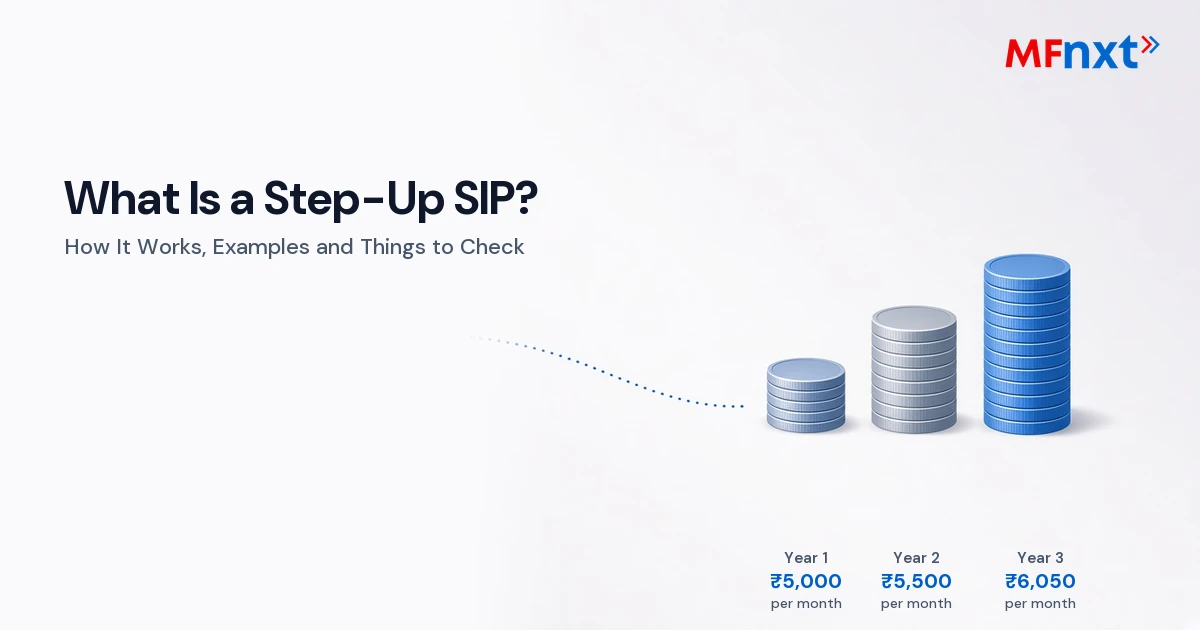
Suppose you started a SIP of ₹4,000 a month. Later, your salary rises.
The SIP still takes ₹4,000. You may wonder whether to leave it there, or to invest more.
A Step-Up SIP is one way to plan that increase. It is also called a SIP Top-Up. It is not a new mutual fund.
Where the facility is offered, it raises the instalment by a fixed amount or a percentage at intervals set in advance.
This page is about that increase, not about a future fund value. If you have not registered a SIP yet, start with How to start SIP investing in India.
What Is a Step-Up SIP?
A regular SIP repeats the same payment on a chosen date. AMFI’s public SIP note describes that fixed, repeating payment. It does not describe a step-up.
A Step-Up SIP keeps the regular debit and adds a planned rise.
At each chosen interval, the instalment goes up by a fixed number of rupees or by a percentage. The higher amount is then debited until the next step.
You can choose only what the form shows. Those choices come from the asset management company (AMC), the mutual fund company, and from the platform.
One form is not a rule for every fund. If the facility is not listed, do not assume it can be added later.
Regular SIP vs Step-Up SIP
Both buy units of the scheme you chose. The useful difference is whether the instalment stays still.
| Point | Regular SIP | Step-Up SIP |
|---|---|---|
| Monthly contribution | Stays at the first amount | Starts at one amount, then rises on a schedule |
| Whether the amount changes | No automatic change | Yes, by fixed rupees or a percentage, if that option is offered |
| How increases are handled | You change it yourself, if a change is allowed | The increase is registered in advance |
| What the investor needs to check | The amount, the date, and affordability | Those points, plus the increase type, frequency, mandate limit, and whether a new registration is required |
A step-up changes later debits. It does not change the scheme or its market risk.
How Does a Step-Up SIP Work?
Public notes describe two kinds of increase. A form may show one, both, or a different label.
Fixed-amount increase
The same number of rupees is added at each step. ₹500 stays ₹500.
Percentage-based increase
Each step is a percentage of the current instalment, so the rupee increase grows over time.
How often the amount rises
Some providers offer a yearly increase. Some also offer a half-yearly increase.
If the frequency is left blank, the form may apply its own default, and that default is not the same at every fund house.
On Invesco Mutual Fund’s September 2025 SIP form, a blank top-up frequency is treated as yearly.
SBI Mutual Fund says that a monthly SIP can use a half-yearly or a yearly top-up, and that a blank frequency defaults to half-yearly.
Those are two fund houses. Check the frequency printed on your own registration form.
Two limits that are not the same
A later increase can be held back by two separate limits. A top-up cap is a ceiling on the SIP instalment itself.
Once the instalment reaches that ceiling, further rises stop. A bank mandate is different. It is the instruction that lets the fund house take money from your account, up to a maximum you authorised.
If a later instalment would go above that authorised amount, the bank may not pay the full increase.
The exact rules differ by AMC. On Invesco Mutual Fund’s September 2025 SIP form, if the instalment after a top-up would exceed the maximum debit on the mandate, the top-up is processed only up to that maximum.
That is one fund house’s form. It is not a rule for every mutual fund. Read both limits on the form in front of you.
Step-Up SIP Example: Starting with ₹4,000
The table starts at ₹4,000 a month and rises by 10% once a year. ₹4,400 is ₹4,000 plus 10%. ₹4,840 is ₹4,400 plus 10%.
Each yearly figure is the monthly instalment times 12. This is a contribution illustration, not a return projection, and it assumes every increase happens.
| Year | Monthly instalment | Amount contributed that year |
|---|---|---|
| Year 1 | ₹4,000 | ₹48,000 |
| Year 2 | ₹4,400 | ₹52,800 |
| Year 3 | ₹4,840 | ₹58,080 |
| Three-year total | ₹1,58,880 |
The total paid in over three years is ₹1,58,880. These figures are contributions only. They are not a projection of returns. Each new monthly amount is assumed for all 12 months of that year. A live SIP may step up in a different month.
The MFnxt SIP calculator estimates a fixed monthly SIP. It uses one monthly amount for the whole period. It does not calculate stepped-up contributions, so it will not rebuild this table.
Fixed Amount vs Percentage Increase
A fixed increase adds the same rupees every time. A percentage increase adds a share of the instalment then in force. Start both at ₹4,000 a mon.
With a fixed rise of ₹1,000 a year, the monthly amount is ₹4,000, then ₹5,000, then ₹6,000. Each step adds ₹1,000.
With a 10% rise each year, the monthly amount is ₹4,000, then ₹4,400, then ₹4,840. The first step adds ₹400. The second adds ₹440, and later steps keep growing.
Check those later amounts against your budget. If the form shows only a fixed rupee top-up, a percentage is not available there.
Can You Use a Step-Up SIP for an Index Fund?
An index fund can be bought through a SIP where the scheme offers one.
A step-up may be available on that SIP where the AMC and the platform support it. It changes the instalment, not the index. If the index falls, the fund can fall with it.
Read what is an index fund for the product, and how to invest in index funds in India for the practical steps.
To understand the difference between a SIP and an index fund, keep the payment schedule and the fund separate.
Can You Increase an Existing SIP?
There is no single way to add a step-up to a SIP you already have. Some AMCs and platforms let you modify it.
Others ask you to register a new SIP, sometimes with a new mandate. Do not cancel the current SIP until you know which route applies, because a new mandate can leave a gap.
Tata Mutual Fund’s note allows a step-up on a new SIP or, where permitted, on an existing one, and says some AMCs require a fresh registration.
Invesco’s SIP form uses a fixed-rupee top-up and says an existing direct-debit SIP must be cancelled and enrolled again.
Those are two fund houses. Confirm the steps on your own platform.
Things to Check Before Starting a Step-Up SIP
Check these on the form, or ask the AMC or platform. Do not borrow a rule from another fund house.
- Support. Both the scheme and the platform offer it.
- Type of increase. Fixed rupees, a percentage, or only one of those.
- Frequency. Yearly, half-yearly, or another interval the form lists.
- Two limits. Any ceiling on the SIP instalment, and, separately, the maximum debit on the bank mandate.
- An existing SIP. Whether it can be modified, or a new registration is required.
- Affordability. Whether later instalments still fit, not only the first.
Also note when the first increase begins, and what happens if an instalment is missed. Those conditions are in the current scheme documents.
Is a Step-Up SIP Right for Everyone?
It can suit someone who expects income to rise and wants the higher debit agreed in advance.
While the registration and the mandate remain in force, the increase happens without a new decision each year, and more money is contributed than under a SIP that never changes.
It fits poorly if those later amounts are unsure. The schedule does not check whether your income rose, so the debit can still go up.
You can instead leave the SIP as it is and raise it later by hand, where the platform allows a change.
A larger contribution is not safer. The same market fall applies to a bigger sum, so a loss in rupees can be larger. A gain can be larger too. Neither is promised.
Frequently Asked Questions
What is the difference between a SIP and a Step-Up SIP?
A regular SIP keeps the same instalment. A Step-Up SIP raises it by a fixed amount or a percentage at chosen intervals, where that facility is offered.
Is Step-Up SIP the same as SIP Top-Up?
Yes. Both names mean a facility that raises the SIP instalment at pre-set intervals. The form may use either name. The terms still depend on the AMC and the platform.
Can I use a Step-Up SIP in an index fund?
Yes, where that index fund offers a SIP and the AMC or platform offers a step-up on it. The step-up changes the instalment, not the index the fund tracks.
Can I change my existing SIP to a Step-Up SIP?
Sometimes. Some AMCs and platforms allow a change. Others need a new SIP, and some need a new bank mandate. Check before you cancel the current SIP.
Can I choose a fixed rupee increase instead of a percentage?
Only where the form offers it. The form may show a fixed rupee increase, a percentage, or both. If only one is shown, that is the choice there.
Does a Step-Up SIP guarantee higher returns?
No. It changes how much is contributed. The units still move with the market. A larger payment does not guarantee a profit or limit a loss.
What happens if my income does not increase?
The increase can still be debited. It does not automatically adjust to your salary or income. Before the next increase, contact the AMC or platform and check whether the SIP can be modified or cancelled.
Conclusion
A Step-Up SIP, also called a SIP Top-Up, schedules higher contributions over time where that facility is available.
The instalment rises by a fixed amount or a percentage, at an interval the form allows.
Read the AMC and platform terms, including any mandate limit and the rule for an existing SIP.
Check that later instalments stay affordable. The facility changes how much you pay in. It does not decide what the investment will be worth.
Sources
- AMFI, Systematic Investment Plan (SIP). A fixed, periodic payment. No Step-Up definition.
- Tata Mutual Fund, What is a Step-Up SIP? Step-Up and Top-up; fixed amount or percentage; some SIPs need a new registration.
- SBI Mutual Fund, investment options. For a monthly SIP, half-yearly and yearly top-up are both listed, and a blank frequency defaults to half-yearly. This is SBI’s term, not a rule for every fund house.
- Invesco Mutual Fund, SIP Top-Up. The yearly default, half-yearly option and mandate maximum are from Invesco’s September 2025 SIP form. Not an industry rule.
This article is intended for educational and informational purposes only. It should not be considered investment advice or a recommendation to buy, sell or hold any particular mutual fund or security.
Mutual fund investments are subject to market risks. Please read all scheme-related documents carefully before investing. Past performance does not indicate future results. The rupee table shows contributions only. It is not a projection of returns.